 Home
Home
 About Us




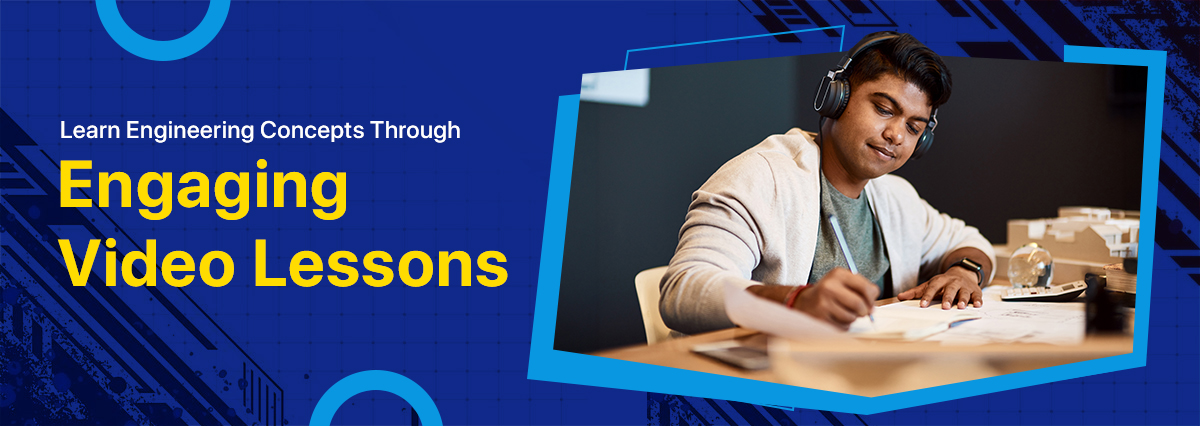
Video learning has become a strong support system for students who need clarity, flexibility, and control over their studies. In a classroom, every student must follow the same pace. Some understand a topic at once, while others need more time, more examples, or a different explanation. Video lessons reduce that pressure. A student can pause, replay, revise, and return to the same concept until it feels clear.
This matters even more for students in higher studies, especially those in engineering, technology, and science. These subjects often include abstract theories, complex diagrams, software tools, lab processes, formulas, and problem-solving methods. A textbook can explain the theory, but a video can show how the idea works in practice.
Why video learning matters for higher studies
Students have to learn subjects that require both theory and application. A concept such as circuit analysis, thermodynamics, machine design, coding logic, or structural mechanics can feel difficult when it stays limited to notes. Video lessons help students see the process step by step.
| Challenge in higher studies | How video learning helps |
|---|---|
| Complex theories | Breaks ideas into clearer visual explanations |
| Long classroom lectures | Allows students to revisit topics after class |
| Problem-based subjects | Shows the method behind each step |
| Software and lab work | Demonstrates tools, commands, and procedures |
| Exam pressure | Helps students revise at a comfortable pace |
| Different levels of preparation | Supports both quick revision and deep study |
For example, for engineering students, video learning also acts as a bridge between classroom knowledge and real-world use. A student may read about a mechanical process, but a video can show the machine, the movement, the forces, and the result. This makes the concept easier to remember and apply.
Why students prefer video lessons
Students do not choose video lessons only because they are convenient. They choose them because the format matches the way many of them now consume information. Short explanations, visual examples, screen demonstrations, and replay options make video lessons feel more direct and practical.
Students lean towards video learning because:
- They can study difficult topics without fear of judgement.
- They can repeat a lesson without delay.
- They can use video lessons before or after classroom lectures.
- They can learn from teachers beyond their own campus.
- They can revise during commutes, breaks, or self-study hours.
- They can connect theory with examples, diagrams, and demonstrations.
This does not make classroom teaching less valuable. Instead, video learning adds another layer of support. A good classroom session builds discussion, discipline, and interaction. A good video lesson gives time, control, and repeat access.
Key benefits of video learning for students
Better control over pace
Every student learns at a different speed. Video lessons respect that difference. A student can slow down near a tough formula, pause after a key idea, or replay a solved problem. This control reduces panic and builds confidence.
Clearer concepts through visuals
Many subjects become easier when students see the idea in action. Diagrams, animations, screen recordings, lab demonstrations, and worked examples can make abstract ideas feel concrete. This is especially helpful in subjects where a small missed step can affect the whole answer.
Stronger revision support
Video lessons are useful before exams because they help students revisit entire topics without depending only on handwritten notes. A student can revise a chapter, check a method, or refresh a concept before an assignment or test.
More accessible study support
Not every student has access to the same teachers, coaching, peer group, or study environment. Video lessons can reduce that gap. Students from smaller towns, remote areas, or busy households can access quality explanations from their own space.
Better link between theory and application
Students must understand how to apply ideas. Video lessons can show case studies, practical problems, simulations, coding steps, design tools, experiments, and real-world uses. This helps students move from “I know the definition” to “I know how this works”. For example, civil engineering students may study load distribution, soil behaviour, concrete strength, or structural design in class. These topics can seem abstract in a textbook. A video lesson can show how a beam reacts under pressure, how soil tests are carried out, or how a bridge design changes when the load increases. It can also demonstrate software tools used for structural analysis, site planning, or project design. This makes the subject more practical and helps students connect classroom theory with real construction challenges.
How students can leverage video learning
| Goal | Smart use of video lessons |
|---|---|
| Understand a new topic | Watch a short concept lesson before class |
| Strengthen classroom study | Review the same topic after the lecture |
| Solve problems | Pause after each step and try the next step alone |
| Prepare for exams | Use videos for revision, then practise without help |
| Learn software tools | Follow demonstrations and repeat the steps on your own device |
| Build project skills | Use videos to understand methods, then apply them to a real task |
The best approach is to treat video lessons as an active study tool, not passive entertainment. A student should keep a notebook, note doubts, solve problems, and test recall after each lesson.
Mistakes students should avoid
Video learning works well only when students use it with discipline. Many students watch many lessons but still feel unprepared because they do not practise enough.
| Common mistake | Better habit |
|---|---|
| Watching without notes | Write key ideas, formulas, doubts, and examples |
| Binge-watching lessons | Study in focused sessions with breaks |
| Skipping practice | Solve problems after each topic |
| Depending only on videos | Use books, class notes, labs, and assignments too |
| Changing teachers often | Follow a structured source for consistency |
| Mistaking familiarity for mastery | Test yourself without the video |
| Ignoring doubts | Ask questions and clear gaps early |
| Watching at high speed always | Slow down for new or difficult concepts |
The biggest mistake is passive viewing. A student may feel that a topic is clear while the teacher explains it, but the real test comes later when the student must solve a question alone. Video lessons should lead to action: notes, practice, recall, and application.
What kind of learners benefit most?
| Learner type | Why video learning helps |
|---|---|
| Visual learners | Diagrams, animations, and demonstrations make ideas clearer |
| Slow-paced learners | Replay and pause options reduce pressure |
| Fast learners | Quick revision videos save time |
| Practical learners | Demonstrations show how concepts work in real situations |
| Remote learners | Lessons can be accessed without travel |
| Exam-focused learners | Topic-wise videos support structured revision |
| Engineering students | Complex processes, tools, and problem methods become easier to follow |
| Working students | Flexible access helps them manage study with other duties |
Video learning can support almost every learner, but the benefit depends on how the student uses it. A visual learner may gain clarity from diagrams. An engineering student may gain confidence from comprehensive engineering study material that include solved problems and lab demonstrations. A student with weak basics may use beginner-friendly lessons before advanced lectures.
Looking for reliable engineering study material?
Our online learning platform makes studying simpler, clearer, and more convenient. We have content created by top academicians and subject experts, which helps students study at their own pace. Instead of just memorising theories, students see real applications explained through engaging animated tutorials. This makes students easier to grasp difficult topics and helps stay confident when they revise for exams.



 Previous Post